How to Win at Tic Tac Toe (and Never Lose)
Updated 2026-10-21
Tic tac toe is a solved game. If both players know what they are doing, every game ends in a draw. That makes it a good game to learn properly: once you know the strategy you will never lose, and you will win whenever your opponent slips. This guide shows how to win at tic tac toe as the player who goes first, how to hold the draw when you go second, the one trap that does all the winning, a checklist for every move, and ways to make a game between two equally good players interesting again.
The rules
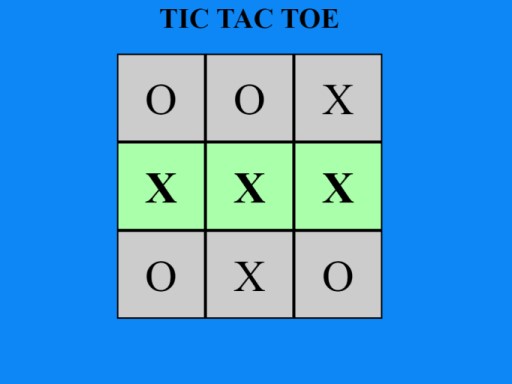
Two players take turns marking squares on a 3 by 3 grid. One plays X and goes first, the other plays O. The first player to get three of their marks in a row, across, down or diagonally, wins. If all nine squares fill up and nobody has three in a row, the game is a draw.
Naming the squares
The nine squares have three types, and each type matters for a different reason. In this guide they are called:
- Corners: top-left, top-right, bottom-left, bottom-right. Each is part of three possible lines.
- Edges: top-middle, middle-left, middle-right, bottom-middle. Each is part of two lines.
- Centre: the middle square. It is part of four lines, more than any other square.
The idea that wins: the fork
A single line of two is easy to stop, because your opponent just blocks the third square. You win with a fork: one move that creates two lines of two at the same time. Your opponent can block only one, and you complete the other.
Almost all tic tac toe strategy is about making a fork and stopping your opponent from making one.
If you go first (X)
Start in a corner
A corner is the best opening against a human. After a corner start, only one reply keeps the game level: the centre. Any other reply loses against correct play, and most people do not know that.
If O answers on an edge, you win by force. Here is the full line, with X opening in the top-left:
- X plays top-left. O plays top-middle.
- X plays the centre. This threatens the bottom-right corner to finish the diagonal, so O has to block there.
- O plays bottom-right.
- X plays bottom-left. This makes two threats at once: the middle-left square (completing the left column) and the top-right square (completing the diagonal from bottom-left through the centre).
- O can block only one, and X wins with the other.
If O answers in another corner, you also win. Say O plays top-right. You play bottom-left, threatening the middle-left square, and O has to block it. Then you play bottom-right, which threatens both the bottom-middle (finishing the bottom row) and the centre (finishing the diagonal from the top-left). That is a fork.
If O takes the centre, play the opposite corner (bottom-right, if you started top-left). Now O has to be careful:
- If O answers in one of the two remaining corners, say top-right, O threatens the bottom-left through the diagonal. You block there, and that block gives you a fork, because you now have two lines of two. You win.
- If O answers on an edge, they have defended correctly. For example O plays top-middle, which threatens bottom-middle through the centre. You block at bottom-middle, which threatens bottom-left along the bottom row. O blocks there, which in turn threatens top-right, so you block that. The game continues with a draw if nobody errs.
Starting in the centre
The centre is also a fine opening. If O replies on an edge, you can win by forcing blocks until you get a fork. If O replies in a corner, correct play leads to a draw.
Avoid starting on an edge
An edge square is part of only two lines, a corner is part of three and the centre is part of four. Starting on an edge does not lose, but it gives you the fewest chances to win.
If you go second (O)
Your goal as O is to hold the draw and to pounce when X goes wrong. Your replies:
- X starts in a corner: take the centre. Any other reply loses against good play. Then, if X takes the opposite corner, play an edge, never a corner. An edge reply makes your own line of two, so X is forced to block instead of building a fork.
- X starts in the centre: take a corner. If you take an edge, X can force a win.
- X starts on an edge: take the centre. A corner next to X's mark also works.
After that, block every line of two and look for X's forks before they appear.
How to stop a fork
There are two ways to stop a fork. The first is to take the square where the fork would happen. The second is to make a line of two of your own, so that X has to block, and that block does not help X. The second way is how O defends in the corner opening: when X holds two opposite corners and O holds the centre, an edge move makes a threat X must answer, and X's block leads nowhere.
A checklist for every move
When it is your turn, go down this list and play the first one that applies. It is the order used by strong players and by simple computer programs.
- Win: if you have two in a row and the third square is empty, take it.
- Block: if your opponent has two in a row, block the third square.
- Fork: make a move that gives you two lines of two.
- Block a fork: if your opponent could make a fork next turn, stop it, either by taking that square or by making a line of two that forces them to block elsewhere.
- Centre: take the centre if it is free.
- Opposite corner: if your opponent is in a corner, take the corner diagonally opposite.
- Empty corner: take any free corner.
- Empty edge: take any free edge.
If both players follow this list, the game is always a draw.
Mistakes that lose games
- Answering a corner opening with an edge. This is the most common error and loses by force.
- Playing an edge as the first move. It does not lose, but it hands your opponent the initiative.
- Taking a corner when you should take an edge. If you are O and X holds two opposite corners, a third corner gives X a fork.
- Making a line of two that does not force anything. If your opponent can ignore it and build a fork, it did nothing.
- Only watching for lines. Players spot a row of two but miss the move that makes two rows of two.
Why it always ends in a draw
There are only nine squares, and 255,168 possible ways a game can be played out. That is small enough for a computer to check every one, and the result is that neither side can force a win against perfect defence. So once both of you know the fork trick, expect a lot of draws. That is the point to try something harder.
Making it interesting again
- Play on a bigger grid. Some online versions offer 5 by 5 or 7 by 7 boards where you need a longer line to win. There is far more room for traps. The game on our tic tac toe 2 player page has these sizes.
- Try a variant with a twist. In magical tic tac toe the rules are different from the classic game, so read the instructions first.
- Move up to four in a row. Connect 4 uses the same idea of lining up marks, but gravity makes it far deeper.
- Play against the clock. Give each player three seconds a move. Mistakes come back quickly.
- Alternate who starts. A first-move advantage matters more than it should, so play a best of five and swap each game.
- Play the reverse. In the misere version, the player who makes three in a row loses. The tactics flip, and everything you learned about forks now helps your opponent.
Play tic tac toe now
Our free tic tac toe games run in your browser, and you can play a friend on the same screen. Try the corner opening a few times and see how often your friend misses the only reply that holds. The best place to start is Tic Tac Toe Multiplayer. Head 2 Head Tic Tac Toe, Simple Tic Tac Toe and magical tic tac toe are also good. You will find more in the Board and Card games category.
Keep reading: how to win at Connect 4, how to play checkers, how to play chess for beginners and the best board games for 2 players.
FAQ
- Can you always win at tic tac toe?
- No. If both players play correctly, every game is a draw. You can only win when your opponent makes a mistake, but with the right strategy you never have to lose.
- What is the best first move in tic tac toe?
- A corner. It leaves your opponent only one safe reply, the centre, so it gives you the most chances to win. The centre is also a good first move.
- What is a fork in tic tac toe?
- A move that creates two lines of two at once. Your opponent can only block one of them, so you win on your next turn.
- What should I do if my opponent starts in a corner?
- Take the centre. It is the only reply that doesn't lose against good play.
- What should I do if my opponent starts in the centre?
- Take a corner. If you take an edge square instead, a good player can force a win.
- Is it better to go first or second in tic tac toe?
- First. The first player has more chances to win, because several second-player replies lose. With perfect play both sides draw.
- How many ways can a game of tic tac toe be played?
- There are 255,168 possible games if you count every legal sequence of moves. Computers have checked all of them, which is how we know the game is a draw with correct play.
- How do you beat someone who never makes a mistake?
- You cannot. A player who follows the checklist draws every game, so the only way to win is to change the game: a bigger grid, a time limit or a different rule set.