How to Play Checkers: Rules, Kings and Tips for Beginners
Updated 2026-10-19
Checkers is a two-player game you can learn in five minutes and keep getting better at for years. A game takes ten to twenty minutes, you need nothing but a board and 24 pieces, and the player who thinks two moves ahead wins most of the time. This guide covers the standard American rules (the same game is called English draughts in Britain), then the opening, seven techniques with concrete board positions, the mistakes that lose beginner games, and a few ways to make a two-player match more interesting. At the end you can play a free game in your browser.
The rules
What you need
- A board of 64 squares in an 8 by 8 grid. Only the dark squares are used.
- 12 pieces for each player, one colour each, usually black (or red) and white.
Turn the board so each player has a dark square in the bottom-left corner.
Setup and who goes first
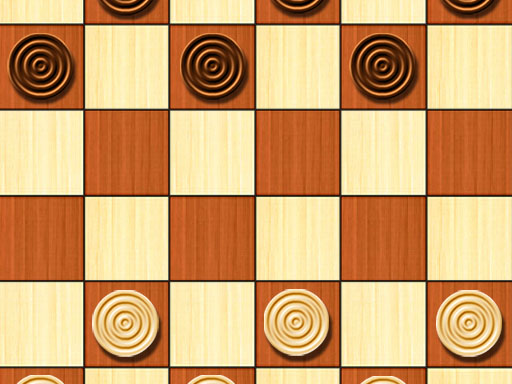
Each player puts their 12 pieces on the dark squares of the three rows nearest to them. The two middle rows stay empty. The player with the darker pieces moves first, then you alternate.
Moving
A normal piece, called a man, moves one square diagonally forward onto an empty dark square. It never moves backward or sideways.
Capturing
If an enemy piece sits on the next diagonal square and the square right behind it is empty, you jump over it, land on the empty square and remove the piece. If your piece can jump again from where it lands, it must keep going in the same turn, and it may change direction between jumps. A man can only jump forward.
Captures are mandatory. If you can jump, you must. If several captures are available you pick whichever you like, but you cannot choose a quiet move instead. Almost every trick in checkers comes from this one rule.
Kings
A man that reaches the far row is crowned: you stack a second piece on it. A king moves and jumps one square diagonally in any direction. If a man reaches the far row in the middle of a jump, its turn ends there. It is crowned, but it does not carry on jumping that turn.
How the game ends
You win when your opponent cannot move, either because you took all their pieces or because the ones left are blocked. If neither side can make progress, the game is a draw by agreement.
Reading the board: a coordinate system
The tips below use the same letters and numbers as chess. Columns run a to h from left to right, rows run 1 to 8 from the bottom, and all positions are described from the point of view of the player at the bottom. With a dark square in the bottom-left corner, a1 is dark, and so are c1, e1 and g1, then b2, d2, f2 and h2 on the next row, and so on up the board. Your men start on rows 1 to 3 and move up. Your opponent starts on rows 6 to 8 and moves down.
Your first moves
You cannot lose the game on move one, but you can set the shape of the whole game. The moves that work well for beginners are the ones that bring a man from your third row toward the middle: c3 to d4, e3 to d4, e3 to f4 or g3 to f4. Moving the pieces on the edge first (such as a3 to b4) puts them where they have only one direction to go.
Keep your two back-row men on c1 and g1 for as long as you can, and bring up the others in pairs. Do not rush a single man up the board on its own. A lone man near the middle usually gets traded off or trapped.
Seven techniques that win games
1. Guard the back row with a bridge
Men on c1 and g1 form what players call a bridge. An enemy man can only be crowned on a1, c1, e1 or g1. With c1 and g1 occupied, it has to come through a1 or e1, and both routes pass a square your bridge men can jump: a man stepping to d2 can be taken by c1 jumping to e3, a man on f2 can be taken by g1 jumping to e3, and one on b2 can be taken by c1 jumping to a3. This only works while those landing squares are empty, so check them before you rely on it.
2. Take the centre
A man on d4, f4, c5 or e5 can go either of two ways next move and can support pieces on both sides. A man on the a or h file cannot be jumped at all, because there is no square behind it, which sounds safe but means it does little. In an even game the player with more men in the middle usually has the better position.
3. Move in pairs and triangles
A man cannot be jumped if the square behind it, on the line of the jump, is occupied by a friendly piece. So keep pieces diagonally behind each other. A triangle of three men (for example c3, d4 and e3) is very hard to break, because every attacker has a friendly piece on the square it would need to land on.
4. Look for the forced capture before you move
Before every move, ask: after this, which of my pieces can the opponent be forced to take, and where does that land them? Ask the same about your own captures. The forced-capture rule means your opponent often has no choice, and that is how you plan ahead.
5. The two-for-one shot
This is the classic trick. You give up one man, the opponent is forced to take it, and the piece that took lands where you can capture two. Here is a small example.
The position. You have men on d4, f4, g3 and h2. Your opponent has men on d6 and f6, and the squares e5, g7 and e3 are empty.
The move. You play your man from f4 to e5. Both enemy men sit next to it, so your opponent has to capture. The man on f6 would jump to d4, but d4 is occupied, so it cannot. The man on d6 jumps over e5 and lands on f4, which you just left. It cannot go on, because h2 is occupied behind g3.
The reply. Your man on g3 jumps over f4 and lands on e5. From e5 it can jump the man on f6, landing on g7. You gave one man and took two.
The shape matters more than this exact position. Look for a square your opponent must jump to, with an empty square behind it, and a second enemy man waiting next to the landing square.
6. Trade when you are ahead
If you have more men, swap one for one. With 12 against 11 the lead is small. With 4 against 3 it is large, and with 2 against 1 it is usually decisive. Trading also removes the pieces your opponent was using for tricks. When you are behind, do the opposite and avoid trades.
7. Learn the end of the game with kings
Once both sides have kings, the board opens up and the game is about cutting off escape routes. The long diagonal from a1 to h8 is the most important line, because a king standing on it can move a long way in both directions. A lone king can often hold a draw against two kings by staying on that line or sheltering in a double corner (the g1 and h2 corner, or the a7 and b8 corner). Three kings against one usually win, but you have to trap the lone king away from the long diagonal. Practise this against a friend: one of you takes three kings, the other takes one, and the stronger side tries to win in 20 moves.
Mistakes that lose beginner games
- Forgetting the mandatory jump. You build a plan, then your opponent offers a man and you have to take it. Check what each forced capture opens up.
- Running one man to the far row alone. It rarely arrives. A king is worth having, but not at the cost of leaving two holes in your formation.
- Emptying the back row early. Once c1 and g1 leave, an enemy man that gets through becomes a king at once.
- Playing only on the edges. Edge men are safe but can be pinned there, and they take no part in the fight over the centre.
- Not counting tempo. Late in a game, whoever runs out of safe moves first has to give up men. If you cannot move without losing a piece, you are probably one move behind in the count.
- Trading when behind. Every swap makes your opponent's lead larger.
Playing against a friend: ways to change the game
Checkers is a solved game: with perfect play from both sides it ends in a draw. That is why two evenly matched friends tend to draw, and why a few changes keep it fresh.
- Play two games, switch colours. Moving first is a small advantage, so the best of two games with colours swapped is fairer than one game.
- Handicap the stronger player. Take one of their men off the board before you start, for example a man from the back row.
- Set a move timer. Ten seconds a move is enough to expose who relies on calculating.
- Try giveaway checkers. In this version you must lose all your pieces (or be blocked) to win, and the capture rule stays mandatory. The tactics are the reverse of normal checkers.
- Try a different rule set. The game below may use different rules from the ones in this guide, so see the next section.
Other versions of checkers
If an online game behaves differently from what you expect, it is probably using one of these rule sets.
- International draughts: 10 by 10 board, 20 pieces each. Men can capture backward, kings can "fly" any distance along a diagonal, and you must take the capture that removes the most pieces.
- Italian draughts: 8 by 8 board. A man cannot capture a king, and you must choose the capture that takes the most pieces. The checkers game on our 2 player checkers page uses this rule set, according to its developer.
- Russian and Brazilian draughts: 8 by 8 boards where men can capture backward and kings fly.
- Turkish draughts: pieces move straight forward and sideways, not diagonally, and each player starts with 16 pieces on the second and third rows. We have a Turkish draughts game too.
Play checkers now
You can play checkers free in your browser with a friend on the same screen, no download or sign-up. Our favourite pick for two players is Master Checkers, and Master Checkers Multiplayer and Classic Checkers: Forest are good alternatives if you want a different look. More board games are in the Board and Card games category.
Keep reading: how to play chess for beginners, how to win at Connect 4, how to win at tic tac toe and the best board games for 2 players.
FAQ
- Do you have to jump in checkers?
- Yes. In the standard rules a capture is mandatory. If you can jump an opponent's piece you must, though you may choose between several possible captures. Once you start a multiple jump you must finish it.
- Can a normal piece move or jump backward?
- Not in American checkers. Men only move and capture forward. Only kings can go backward.
- How does a piece become a king?
- It reaches the row furthest from its owner and is crowned. From then on it moves and captures one square diagonally in any direction.
- Who goes first in checkers?
- In the standard American rules, the player with the darker pieces moves first.
- What is the best first move in checkers?
- There is no single best move, since the game is a draw with perfect play. For beginners, moves that bring a man from the third row toward the centre, such as c3 to d4 or g3 to f4, are a safe start. Keep the back-row men on c1 and g1 for later.
- Can you win checkers by blocking instead of capturing?
- Yes. You win when your opponent has no legal move, whether their pieces are captured or simply blocked.
- Is checkers a solved game?
- Yes. Computer analysis of the 8 by 8 game showed that with perfect play from both sides it ends in a draw. Against real opponents, mistakes decide the game.
- How long does a game of checkers take?
- Usually ten to twenty minutes. A game against a friend who plays fast can be over in five.