How to Win at Connect 4: Strategy and Tips That Work
Updated 2026-10-20
Connect 4 looks like a children's game, but there is real strategy under the surface. Computers solved it in the late 1980s: with perfect play, the player who moves first can always win. Nobody plays perfectly, so the game is decided by a few ideas you can learn in one sitting. This guide goes from the rules to the first move, seven techniques with board positions, the odd and even row rule that strong players use in the endgame, and the mistakes that lose most casual games. At the end there is a free game to practise on.
Connect 4 and Connect Four are trademarks of Hasbro. This page is an independent guide and is not affiliated with or endorsed by Hasbro.
The rules in one minute
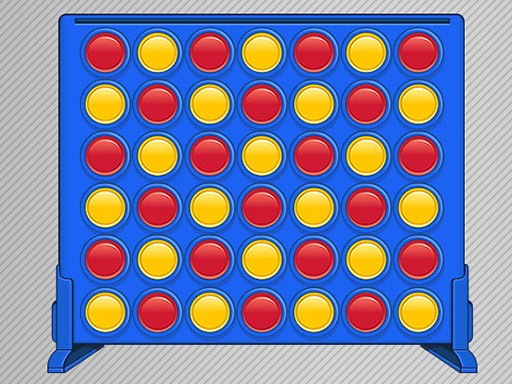
The board has 7 columns and 6 rows, 42 spaces in total. Two players take turns dropping one disc into a column, and the disc falls to the lowest empty space. The first player to line up four of their own discs, across, up and down, or diagonally, wins. If all 42 spaces fill up with no line of four, the game is a draw. There are 69 different lines of four on the board: 24 across, 21 up and down, and 24 diagonal.
How to read the board in this guide
To describe positions, columns are lettered A to G from left to right and rows are numbered 1 to 6 from the bottom. So D1 is the bottom space of the middle column and D6 is the top. A disc on D3 means the third disc in the middle column.
The first move
The centre column (D) is the most valuable on the board. A disc in the middle can be part of a line going left, right, or along either diagonal, and every horizontal four on the board must include a disc in column D. Computer analysis has shown how the first move decides the game under perfect play:
- First move in column D: the first player wins.
- First move in column C or E: the game is a draw.
- First move in column A, B, F or G: the second player wins.
So if you move first, play D1. If you move second and the middle is already taken, put your disc on top of it (D2) or next to it (C1 or E1) and keep fighting for columns C, D and E during the opening.
Seven techniques that win games
1. Check for a win, then check for a loss
Before every move, run through the same two questions in this order:
- Can I win right now? If you have three in a line with a playable space at the end, take it.
- Can my opponent win on their next move? If so, block.
Most casual games end because one player was busy with their own plan and missed a line of three. Make the two checks a habit and you will win a lot of games without any other skill.
2. Never play under your opponent's winning square
You can only play on a space if the one below it is filled, so your own move can open a space for your opponent. Before you drop a disc, look at the space directly above where it will land. If your opponent could win by playing there, your move hands them the game.
The same idea works in your favour. If you need a square, try to make your opponent the one who has to fill the space below it.
3. Stop the open two on the bottom row
This is the trap that catches most beginners. Suppose you have discs on D1 and E1, and C1, F1, B1 and G1 are all empty. If you play F1 you have three in a row on D1, E1, F1, and both C1 and G1 are playable. Your opponent can block only one, and you win with the other.
The same applies against you. When your opponent has two discs side by side on the bottom row with open space on both sides, block one end immediately. Do not wait until they have three. The same pattern works on higher rows once the spaces underneath are filled, so look for it whenever two of your discs are adjacent with room on both sides.
4. Build a double threat
The winning move in almost every game is a position where you have two different ways to make four on your next move. Your opponent can stop only one. The open two on the bottom row is the simplest example. Others to look for:
- A horizontal three with both ends playable, as above.
- A horizontal three and a diagonal at once. One extra disc finishes either line.
- A vertical three plus a second threat. A vertical three is easy to block alone, because your opponent just covers the top. But if the same disc also builds a second line, they cannot cover both.
Moves that make a threat are useful even if the threat is easy to block, because they force your opponent to reply and you choose where the game goes next.
5. Stack two threats on top of each other
Suppose your winning squares are D3 and D4, one above the other, and nobody has played D2 yet. If you play D2, your opponent has to block D3, which makes D4 playable, and you play D4 and win. If your opponent plays D2 first, you play D3 and win. Either way you win, as long as you can play D2 safely. Two stacked threats in the same column are close to unstoppable.
6. Understand the diagonal staircase
Say you have discs on B1, C2 and D3, a diagonal staircase with E4 as the winning space. E4 is not playable until E1, E2 and E3 are filled. If you play E3, your opponent blocks E4. If your opponent plays E3, you win on E4. So neither player wants to play E3, and the other columns will fill up while that column waits. When the rest of the board is full, someone is forced to move there. This is where the odd and even rule decides who it is.
7. The odd and even row rule
When the other columns are full and one column is left, the winner of the waiting game depends on who started. Counting rows from the bottom:
- The player who moved first gets the squares in odd rows (1, 3 and 5), because each full column holds an even number of discs and that player always moves into the lowest free space.
- The player who moved second gets the squares in even rows (2, 4 and 6).
If the staircase is yours and you went second, E4 is on row 4, an even row, so it is a good threat for the second player and a poor one for the first. If you went first, build your threats on rows 3 and 5. If you went second, build them on rows 2, 4 and 6. You don't need to count every move, just keep the rule in mind: first player, odd rows; second player, even rows.
Common mistakes
- Playing the edge columns early. A disc on column A or G has fewer lines running through it than a disc in the middle.
- Looking only across and up. Most surprise wins are diagonal. Check the diagonals every turn.
- Filling a column without looking above. The most common way to give away a game is dropping a disc that makes the winning space playable for your opponent.
- Blocking too late. Block when your opponent has two with open ends, not when they have three and a double threat.
- Building threats on the wrong row. A threat on an even row is of little use to the player who moved first, and the other way round.
- Ignoring tempo. Late in the game, safe moves are a resource. If you run out of columns you can play without losing, you lose.
Playing against a friend: ways to change the game
Because the first player can force a win in theory, games between people who know the trick are decided by who knows the position better. A few simple changes keep a series fair and fun:
- Alternate who goes first over a best of three or five.
- Ban the first player from opening in the middle column. The game stays balanced and the opening becomes a puzzle.
- Use a timer. Ten seconds a move forces quick pattern reading.
- Handicap the stronger player. Let the weaker player start every game, in the middle column.
Practise online
Our free four-in-a-row games run in your browser, and you can play a friend on the same screen. Try them one idea at a time. First play D1 every game and notice how often you control the middle. Then try to build a double threat. After that, play for a stacked pair. Can Has Connect 4 is a good place to start. If you want other versions, try 4 in a row - Board game for 2 players, Connect 4 Multiplayer or 4 in Row Mania. All of them are in the Board and Card games category.
Keep reading: how to win at tic tac toe, how to play checkers, how to play chess for beginners and the best board games for 2 players.
FAQ
- Can the first player always win at Connect 4?
- Yes, in theory. The game was solved by computer: the first player can force a win by starting in the centre column and playing perfectly. In practice people make mistakes, so either player can win.
- What is the best first move in Connect 4?
- The centre column. A disc in the middle can be part of more winning lines than a disc anywhere else. Starting in the columns next to it gives a draw with perfect play, and starting on an edge column loses.
- How do you always win at Connect 4?
- If you move first, start in the centre and follow the checks: win if you can, block if you must, never play under your opponent's winning square, and build a double threat. Against a player who makes no mistakes the first player's win is very hard to find, but most people slip.
- What is a double threat?
- A position where you have two different ways to make four on your next move. Your opponent can only block one of them, so you win with the other.
- What does the odd and even rule mean?
- Counting rows from the bottom, the first player tends to get squares in odd rows when columns fill up, and the second player tends to get squares in even rows. So you want your winning squares on the rows that suit your turn order.
- How big is a Connect 4 board?
- 7 columns and 6 rows, which is 42 spaces in total.
- How many ways are there to win at Connect 4?
- 69 lines of four: 24 horizontal, 21 vertical and 24 diagonal.
- Is it better to go first or second in Connect 4?
- First, if you start in the centre. The second player should aim for threats on even rows and can usually only win if the first player makes a mistake.