How to Play Backgammon: Rules for Two Players
Updated 2026-10-16
Backgammon is one of the oldest board games in the world, and it is a game for exactly two players. It mixes luck (you roll dice) with real skill (you choose how to use them), which is why beginners can win a game and experts still enjoy it. This guide explains the board, the setup, how to move, how to hit your opponent, how to bear off and how to win. At the end there is a free backgammon game you can try in your browser.
What you need
- A backgammon board, which has 24 narrow triangles called points.
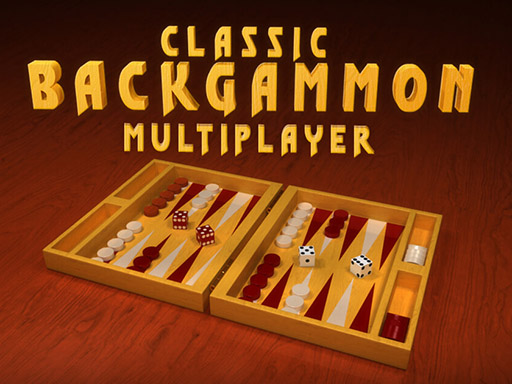
- 15 checkers for each player, in two colours (in the free game we tried, they are cream and red).
- Two dice.
The board is divided into four sections of six points each: your home board, your outer board, and your opponent's home and outer boards. A bar runs down the middle between the two halves.
The goal
Move all 15 of your checkers around the board and into your home board, then take them off the board. The first player to bear off all 15 checkers wins. The two players move in opposite directions.
The starting setup
Each player starts with their checkers in the same pattern, mirrored across the board. Counting from your own side:
- 2 checkers on your 24-point (the far end of the board).
- 5 checkers on your 13-point (the middle of the board).
- 3 checkers on your 8-point.
- 5 checkers on your 6-point (in your home board).
Your home board is the six points where you finish. You move your checkers from your highest-numbered points down towards the 1-point and then off the board.
Who goes first
At the start, each player rolls one die. The player with the higher number goes first and uses both numbers as their first move. If you tie, roll again.
How to move
On your turn, you roll both dice. Each die is a separate move. If you roll a 5 and a 3, you can move one checker 5 points and another checker 3 points, or one checker 8 points in total (moving 5, then 3, or 3, then 5).
The rules for where a checker may land are simple:
- You can land on an empty point.
- You can land on a point where you have your own checkers.
- You can land on a point where your opponent has only one checker. This is called a hit (see below).
- You cannot land on a point where your opponent has two or more checkers. That point is blocked.
You must play both dice if you can. If only one of them can be played, you must play it. If neither can be played, you lose your turn.
Doubles
If you roll the same number on both dice (a double), you play that number four times. For example, a double 4 lets you make four moves of 4 points each. In the free game we tried, a message told us the dice were doubled when we rolled one.
Hitting a blot
A single checker on a point is called a blot. If your opponent lands on it, it is hit. The hit checker is taken off the board and placed on the bar.
When you have a checker on the bar:
- You must bring it back into play before you make any other move.
- You enter it in your opponent's home board, on the point that matches the number on one of your dice. For example, with a 4, you enter on the point four steps from the edge.
- If that point is blocked (your opponent has two or more checkers there), you cannot enter with that number. If both dice are blocked, you lose your turn.
Hitting is how you gain ground in backgammon, because the hit checker has to start its trip again.
Making points and blocks
Two or more of your checkers on the same point are safe, because your opponent cannot land there. Building a row of points in a line, called a prime, can trap your opponent's checkers behind it. A full prime of six points in a row can't be passed at all.
Bearing off
Once all 15 of your checkers are in your home board, you can start bearing off, which means taking checkers off the board.
- A number on a die lets you remove a checker from the point with the same number. A 6 removes a checker from your 6-point, and a 3 removes one from your 3-point.
- If you roll a number higher than your furthest checker, you can remove a checker from your highest occupied point.
- If you can't remove a checker, you must move one inside the home board.
- If one of your checkers is hit while you are bearing off, you must bring it back round the board before you can carry on bearing off.
The first player to remove all their checkers wins.
Scoring
A normal win scores 1 point. Two bigger wins are worth more:
- Gammon (2 points): you win before your opponent has borne off any checker.
- Backgammon (3 points): you win while your opponent still has a checker on the bar or in your home board.
Many players also use a doubling cube, a die with 2, 4, 8, 16, 32 and 64 on it. During the game, a player can offer to double the stakes. The other player either accepts, which means they own the cube, or gives up the game and loses the current stakes. The free game we tried did not show a doubling cube.
Tips for beginners
- Don't leave blots near your opponent's checkers. A blot within reach is likely to be hit.
- Make your home board strong. Points in your home board make it hard for your opponent to enter from the bar after you hit them.
- Keep your checkers together. Pairs on the same point protect each other.
- Move your back checkers when it's safe. The two checkers on your 24-point are the hardest to bring home, so don't leave them behind for too long.
- Count the race. If you are ahead in the race and there is no contact left, just run home as efficiently as you can.
Play backgammon online
Our free backgammon game runs in your browser. In the version we tested, you could play against the computer or against a friend on the same screen. When you click a checker, the point it can move to lights up, so it is a good way to learn how the dice work. See the game below.
More games to play with two: Reversi, dominoes and our list of the best board games for 2 players.
FAQ
- How many checkers does each player have in backgammon?
- 15 each. Each player starts with 2 on the 24-point, 5 on the 13-point, 3 on the 8-point and 5 on the 6-point, counting from their own side.
- What happens when you roll doubles?
- You play the number on the dice four times instead of two. For example, a double 3 gives you four moves of 3 points.
- What is a blot, and what does it mean to hit one?
- A blot is a single checker on a point. If your opponent lands on it, it is hit and goes to the bar, and its owner must bring it back into play before making any other move.
- How do you win at backgammon?
- Bring all 15 of your checkers into your home board, then bear them all off the board before your opponent does.
- What is a gammon?
- A win before your opponent has borne off a single checker. It scores 2 points instead of 1.